

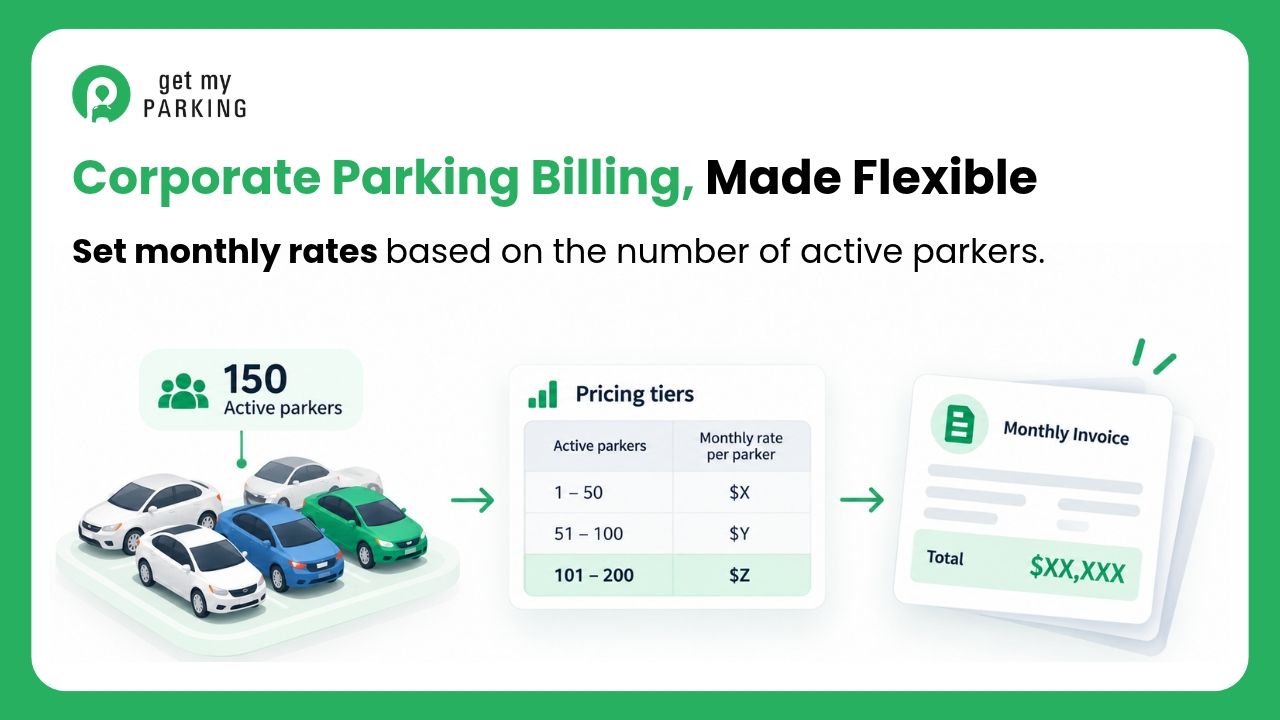
A Smarter Way to Bill Corporate Parking Permits
Corporate parking contracts can get complicated when different companies have different pricing agreements. One tenant may receive a volume discount, another may pay more for additional parking, and a third may have a fixed minimum billing commitment.
Managing these arrangements with a single flat rate can make it difficult to reflect the terms of each contract accurately.
Get My Parking’s multi-tier billing gives operators more flexibility. It allows corporate accounts to be charged based on how many parkers actively use their permits, with predefined pricing tiers instead of a single flat rate.
Here are five scenarios where flexible billing and contract settings can help.
1. Charge Different Rates at Different Usage Levels
The scenario: A corporate tenant has an agreed rate for its initial group of parkers, with a different rate applying when usage increases.
How to approach it: Configure pricing tiers based on active parker counts, with each tier reflecting the rates agreed upon in the contract.
For example, the first 20 active parkers could fall under one pricing tier, while additional active parkers fall under another. The billing structure can then reflect the configured rates as usage changes.
2. Offer Volume-Based Discounts
The scenario: A company receives a better rate per parker when it commits to a higher parking volume.
How to approach it: Set up pricing tiers that reflect the volume discounts in the agreement. Higher usage levels can have lower rates where the contract specifies them.
This helps operators accommodate corporate agreements that reward larger parking commitments without having to rely on one flat rate for every account.
3. Charge Higher Rates for Additional Usage
The scenario: Parking is in high demand, and a corporate agreement specifies a higher rate for usage beyond an initial threshold.
How to approach it: Configure a higher pricing tier for the relevant active parker count, in line with the agreed contract terms.
This allows operators to accommodate pricing structures designed to manage additional demand while keeping billing aligned with the corporate agreement.
4. Account for Minimum Billable Quantities
The scenario: A company agrees to pay for a minimum number of parking permits each month, even if fewer parkers actively use them.
How to approach it: Configure the applicable minimum billable quantity as part of the account’s billing arrangements, where supported by the platform setup.
For example, a contract may require payment for at least 30 permits each month, even if fewer than 30 are in use. This requirement needs to be reflected in the billing configuration rather than relying on active usage alone.
5. Set Maximum Permit Allocations
The scenario: A corporate tenant has an agreed limit on how many parking permits it can receive.
How to approach it: Set the maximum permit allocation according to the contract and available parking capacity, using the relevant permit-management settings.
This helps operators manage corporate allocations against agreed limits. The allocation limit is a separate consideration from the pricing tiers used for billing.
Make Your Billing Work for Your Contracts
Corporate parking agreements can include different rates, volume discounts, usage thresholds, minimum commitments, and allocation limits. The challenge is accommodating these requirements without creating unnecessary manual work for operators.
Multi-tier billing in Get My Parking helps operators manage different pricing structures based on active parker counts. Combined with the relevant billing and permit-management settings, it can support a wider range of corporate parking arrangements. Review your corporate parking contracts and see how you could make better use of the billing capabilities Get My Parking had for you.